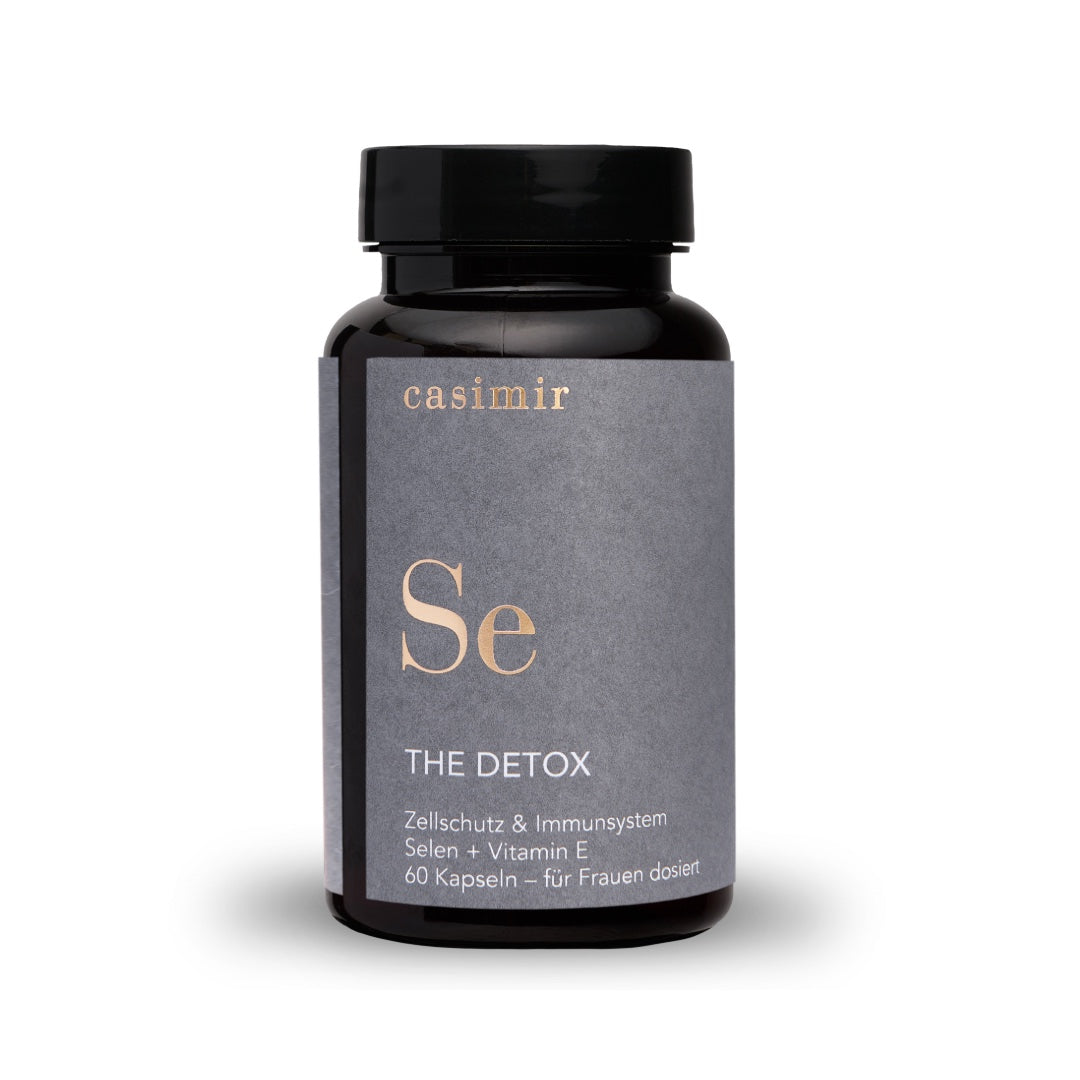
About Selenium, Vitamin E, Astaxanthin, and Chlorella
Selenium is not all the same. There are different selenium compounds that are absorbed differently by the body. We use selenomethionine. Selenomethionine (organic selenium) has a half-life more than twice as long as sodium selenite (inorganic selenium), making it ideal for long-term selenium supply. The body cannot produce selenium itself, which is why it must be regularly taken in through food or supplemented.
Selenium is found in various ways in all organs and tissues of our body. In the event of a deficiency, the body automatically redistributes it to supply the most important organs, leading to an automatic undersupply of this important trace element elsewhere. Selenium is a component of numerous enzymes and is therefore involved in a multitude of reactions in the body. As a component of antioxidant enzymes, selenium is consequently anAntioxidant. Among other things, it is important for protecting the body from cell damage caused by free radicals, which are formed by internal and external influences such as radiation, environmental toxins, pesticides, smoking, etc. Selenium can bind and excrete heavy metals and is therefore indispensable for the body's own detoxification.
Selenium also plays an important role in theimmune defense, as it is involved in the formation of antibodies and supports the immune system through its antioxidant properties and its ability to bind and excrete heavy metals.
It is also known that selenium is related to the production ofthyroid hormones. Together with iodine, it is the most important element for a functioning thyroid, as it controls the activation and deactivation of thyroid hormones.
Not insignificant is also the fact that selenium can improve mood, as it is involved, among other things, in serotonin production (the happiness hormone), which ensures inner calm, balance, and contentment.
It has been proven that selenium influences healthy hair growth and the growth of healthy nails, which is why it is a popular beauty and anti-aging trace element for many women.
WHAT IS SELENIUM IMPORTANT FOR?
Selenium is a vital, essential nutrient and contributes to:
• normal sperm formation
• the maintenance of normal hair
• the maintenance of normal nails
• the normal function of the immune system
• normal thyroid function
• protecting cells from oxidative stress
Increased selenium requirement:
- for smokers
- for rheumatic diseases
- for thyroid diseases
- for cancer
- for cardiovascular diseases
- for a susceptible immune system
- for gastrointestinal diseases
- for chronic diseases
- for a vegan diet
WHAT IS VITAMIN E IMPORTANT FOR?
We use a natural source of Vitamin E, which means that our compound contains no foreign isomers (structural chemical compounds), leading to higher bioavailability.
Vitamin E has many positive effects on our body – as anantioxidant, it helps to combat harmful compounds (free radicals) in our cells. These free radicals can be promoted by various factors, such as inflammation in the body, UV radiation, stress, nicotine, and environmental toxins. They have a cell-damaging effect and are also associated with the development of various diseases such as cancer and aging processes.
In addition, Vitamin E has the property of protecting oxidation-sensitive substances and body structures, which is why it is also often used as anantioxidant.
Furthermore, Vitamin E can help reduce the clumping of platelets in the arteries.
VITAMIN E CONTRIBUTES TO:
- the protection of cells from oxidative stress
INCREASED VITAMIN E REQUIREMENT:
- for pregnant women and during breastfeeding
- for competitive athletes
- for smokers
- for stress
- for environmental stressors (e.g., pesticide exposure, radiation, air and water pollution)
- for high consumption of polyunsaturated fatty acids
- for general disturbance of fat absorption due to organ damage
WHAT IS ASTAXANTHIN GOOD FOR?
Astaxanthin belongs to the carotenoids. Carotenoids are natural plant pigments responsible for the vibrant colors of many fruits, vegetables, and marine animals. We use astaxanthin from the alga Haematococcus pluvialis, which is responsible for the red color in salmon, lobster, and shrimp, among others, as this alga is part of the diet of all these animals. Algae produce astaxanthin in genuine emergencies, as this substance helps them survive many weeks without water/food.
Due to its special structure, astaxanthin has particularly strongantioxidant propertiescompared to many other antioxidants. It is considered one of the strongest antioxidants in the world, making it a true super-antioxidant hero. Astaxanthin also has anti-inflammatory properties. It is believed to have the ability to cross the blood-brain barrier, which means it can support the central nervous system directly in protecting against inflammation and free radicals. In addition, it is also said to serve to protect the eye directly in the retina. And it is said to be able to distribute itself extremely effectively throughout the body and therefore be able to use its properties particularly well.
In a study comparing various antioxidants, astaxanthin performed significantly better in direct comparison to other antioxidants in terms of its ability to eliminate free radicals and neutralize active and reactive singlet oxygen.
Since many complaints in the human body (e.g., joint diseases, inflammation, vision problems) are due to oxidative stress, it is all the more important to combat the resulting free radicals, whereby astaxanthin can be a great help.
ABOUT CHLORELLA:
The microalga Chlorella is a true natural superfood. It has existed for over 2.5 million years and is a true survivor, which makes it particularly exciting for research. There are numerous scientific studies on Chlorella that prove its positive properties. Superfoods are characterized, among other things, by having an increased content of nutrients, e.g., proteins, minerals, and vitamins. Chlorella is particularly known as anantioxidant, as it is said to have the ability to bind and excrete heavy metals in the body. Due to its numerous interesting properties and high nutrient content, Chlorella can be used in many ways. The microalga has the highest chlorophyll content of all plants. Chlorophyll is very similar to human blood pigment hemoglobin in its chemical structure, which suggests that this fact can only be useful for human blood. The higher the chlorophyll content of a food, the greater the health benefits. In addition, the antioxidant powers of chlorophyll support the body against free radicals, thereby preventing their spread, accumulation, and inflammatory processes.
Chlorella contains, among other things:
- Vitamins: A, B6, C, D, E, and K
- Minerals: Magnesium, Calcium, Potassium, and Sodium
- Trace elements: Iron, Zinc, Copper, Manganese, and Selenium
Chlorella is a natural superfood and can*:
- support the detoxification of heavy metals
- support the normal function of the immune system
- improve cell activities
- balance hormone levels
- reduce inflammation
- lower cholesterol levels and blood pressure
- improve oxygen saturation (e.g., improve aerobic endurance for athletes)
- activate metabolism
- stimulate the formation of red blood cells
*The European Food Safety Authority (EFSA) has a number of unofficial claims for food supplements that are not confirmed as official health claims due to a lack of clinical studies - such as superfoods (https://www.efsa.europa.eu/de). However, there are numerous positive experience reports. Therefore, they are often used as home remedies or natural remedies.