What happens during perimenopause?
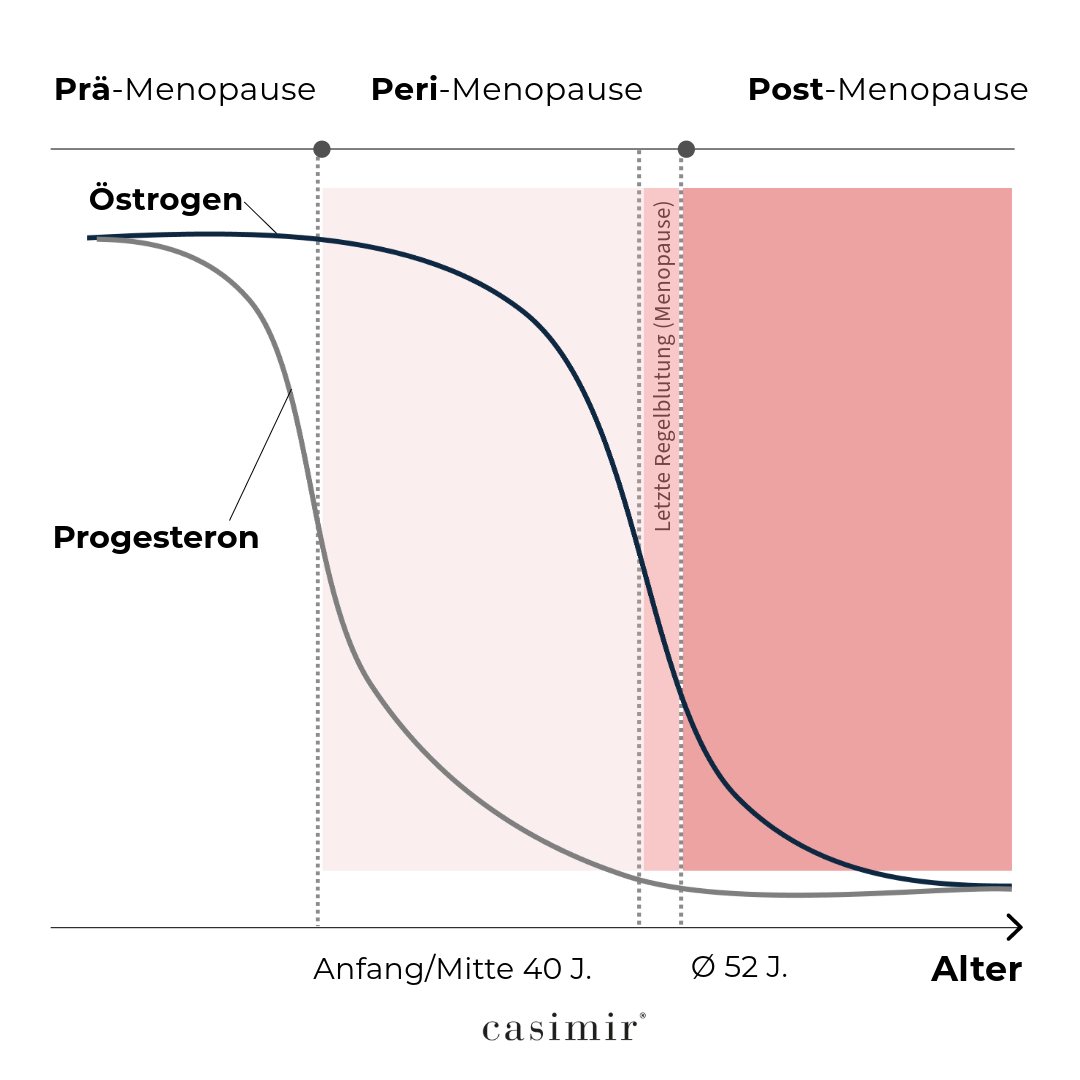
Perimenopause is the first of the three stages of menopause. During this phase, the production of the female sex hormone progesterone typically decreases, leading to estrogen dominance. Ovarian function declines. Perimenopause can gradually begin as early as the late 30s. The common perception begins in the mid-40s. Early signs can include: irregular bleeding, shorter menstrual cycles, increased susceptibility to bladder infections, sleep problems (with or without hot flashes), impaired metabolism. Even at this stage, doctors often recommend hormone replacement therapy, which may not be necessary, as plant-based alternatives with hormone-like receptors can already lead to more balance and equilibrium.
What is progesterone?
Progesterone is a sex hormone from the group of gestagens (luteal hormone) that prepares the female body for a possible pregnancy and also plays an important role during pregnancy. Progesterone is produced in greater quantities in women during the second half of the cycle and stimulates the growth of the uterine lining to prepare for the possible implantation of a fertilized egg. A decrease in progesterone, as is common in perimenopause, can therefore cause noticeable cycle problems.
What happens during menopause?
Menopause (climacteric) encompasses the phase of a woman's life in which the - naturally intended - hormonal change takes place. The ovaries reduce their hormonal production. From a balanced, fertile state of the female sex hormones estrogen (formation before ovulation) and progesterone from the group of gestagens (formation after ovulation) through the "transition" to the complete breakdown of these hormones and natural infertility into the state of menopause. This entire phase can begin as early as the late 30s. It noticeably begins on average in the early to mid-40s and usually ends in the mid to late 50s. If the cessation of menstrual bleeding has been more than a year ago, menopause has definitely set in. The duration of menopause can be between 5 and 10 years. The entire period can be divided into three different phases:
Perimenopause:Decrease in hormone production, phase of slowly ceasing menstruation. (possible onset age late 30s to late 40s)
Menopause: Significant cycle irregularities and a stronger increase in menopausal symptoms (possible onset age mid-40s to mid-50s)
Postmenopause:The end of the fertile phase (no more egg maturation and no more menstruation). A new hormonal balance is established. Menopausal symptoms are reduced. (Possible onset age mid-50s to 60)
Regarding age information, it must be mentioned that every female body is different and the different phases do not have to apply to every woman. In addition, not every woman perceives the individual phases equally clearly. The information is only intended to provide guidance and can serve as a guide to interpret possible symptoms.
In the specialist literature, one often reads about the four phases of menopause, divided into pre-, peri-, meno- and postmenopause. Perimenopause is referred to as the phase before menopause, where initial signs appear that are perceived by attentive women and can be attributed to the onset of menopause. We have summarized menopause and postmenopause here as the last phase of menopause, in which no ovulation definitely takes place anymore and the last menstrual period is a year or more ago.
What complaints do women have during menopause?
The majority of women in menopause experience complaints and suffer from hot flashes, night sweats, headaches, exhaustion, sleep disorders, decreased fluid balance, wrinkles, hair loss, dry mucous membranes (vaginal dryness), decreased sexual desire, frequent bladder infections, increased vaginal itching, mood swings, nervousness, irritability, accumulation of abdominal fat, possible onset of bone loss, fatigue, listlessness, decreased performance, lack of concentration, and urinary incontinence. These symptoms can vary in severity and individually.
However, there are also women who experience menopause relatively symptom-free and only experience a short transition.
Who is this product suitable for?
- Suitable for women in perimenopause who want to specifically supplement their daily routine with a plant-based micronutrient complex.
- Women aged 35 and over, in perimenopause with sleep problems and inner restlessness.
- for hormonal fluctuations
- for the need for "natural support"
- for rejection of classic hormone therapies
- Sleeping through despite hormonal changes
- night waking menopause
- not sleeping through 40+ hormones
- natural sleep menopause
- inner restlessness due to hormonal fluctuations
- inner restlessness menopause naturally
- hormonal nervousness
- finding calm in menopause naturally
- alternative hormones in menopause naturally
- no hormones in menopause
- plant-based hormones for women 40+
- irregular cycle from 40
- perimenopause symptoms treated naturally
- hormones out of balance woman 40+
- sleep problems due to hormonal changes in women over 40
Description
During menopause, hormone levels fluctuate. This can lead to various complaints (see "About Menopause and Climacteric"). With the help of "plant-based hormones", the hormone level can be rebalanced.
Since there can often be confusion about the terminology, we have listed and explained the most important terms here:
- Isoflavonesand Lignansare secondary plant compounds from the group of Phytoestrogens. They resemble the body's own hormone estrogen in structure and effect, which is why the term "plant-based hormones" is derived from them.
- Flavonesare the superordinate group of Flavonoidsand also belong to the group of phytoestrogens. These are secondary plant compounds that also resemble the body's own hormone estrogen in structure and effect, but to a lesser extent. In addition to antioxidant properties that can protect the human body from free radicals, they are also said to have the properties of being able to reduce the risk of cancer, cardiovascular diseases and cholesterol, and can have a positive effect on the immune system.
- Diosgeninis a plant-based active ingredient and a distant precursor of the human hormone progesterone. It is often used as a natural remedy to relieve symptoms of menopause. It also has antioxidant properties that can help protect cells from free radicals.
- Gestagensare also hormones that belong to the female sex hormones. They are corpus luteum hormones that belong to the steroids. One of the most important representatives of gestagens is progesterone. Progesterone, along with pregnanediol and pregnenolone, thus belongs to the group of gestagens.
About Yam Root
The yam root, also called yam, is a tuber that is a staple food in Africa and South America, comparable to the potato. It has a high starch content, contains fiber and many other valuable micronutrients such as vitamin C, B1, B2, B3, B5, B6 and B9, potassium, calcium, magnesium, zinc, manganese, iron and copper. It also contains many antioxidants and can be described as a true superfood. An important ingredient, especially with regard to menopause, is the high proportion of diosgenin, a precursor of the human hormone progesterone, which counteracts estrogen dominance and regulates the unbalanced hormone balance during menopause. Thousands of years ago, indigenous peoples used yam root to treat menstrual complaints or labor pains. The tuber also has anti-inflammatory properties and is used for colds, inflammation and other problem areas. Yam has an antispasmodic effect and has a positive effect on stress and inner restlessness. The high phosphorus content is important for bone strength, teeth and cells. In addition, diosgenin has a positive effect on memory performance.
We use yam root extract (the concentrated extract of the substance), which has a higher diosgenin content (20%).
About Fenugreek
Fenugreek, also called Greek hay, is a plant from the family of legumes, whose seeds and leaves are said to offer a variety of health benefits. It has existed for several thousand years and has been revered as a remedy ever since. Hildegard von Bingen and Sebastian Kneipp already praised its alleged healing powers. It is used in traditional medicine in China, India and Tibet. Mothers with breastfeeding problems (although not recommended for breastfeeding women) use it in traditional medicine. It contains the amino acid histidine and the phytohormone diosgenin. Fenugreek is also a popular seasoning in North African, Southern European and Asian cuisine in various forms of administration. Fenugreek has a high protein content, contains fats, essential oils, bitter substances, valuable vitamins (especially vitamin A and all B vitamins, except B12) and important minerals (especially iron and magnesium). It is used for hair loss and skin problems and also contains many antioxidants. Its anti-inflammatory properties are also often used for inflammation. The interesting substances of fenugreek are found in its seeds, which is why we use fenugreek seed extract (the concentrated extract of the seeds), which has a higher content of the ingredients.